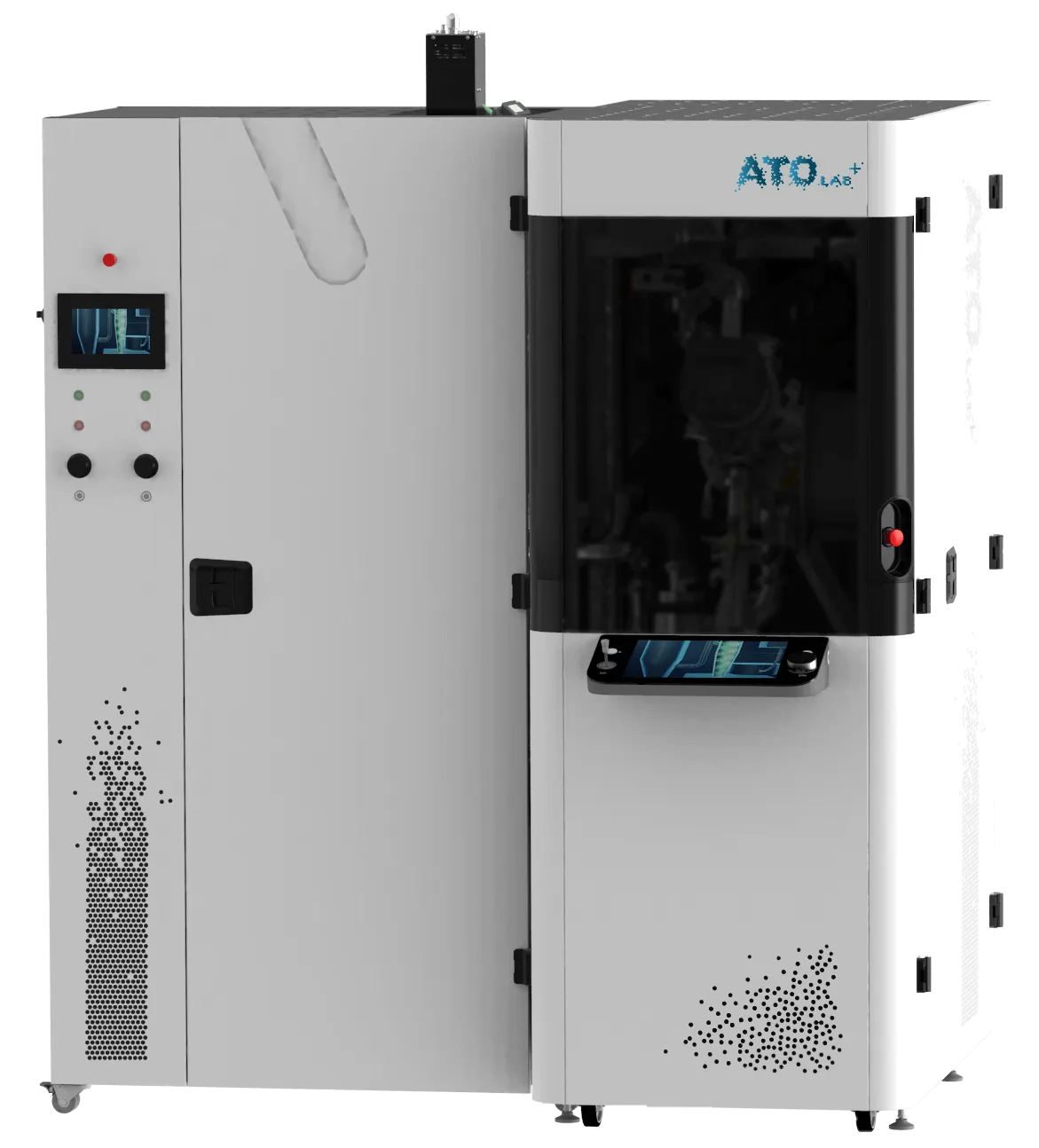
The ATO Induction Melting System (IMS) is an optional module designed to atomize materials and minimize evaporation of low melting point elements.
Build Volume
Dimensions
Technology
Induction Melting
Description
Technical Specifications
Technology
Materials Supported
The ATO Induction Melting System (IMS) is an optional and easy-to-swap module designed to increase the capabilities of the ATO ultrasonic metal atomizers. Dedicated for ultrasonic atomization, this device powders metals and alloys into a fine, homogenous powder. It’s designed to atomize materials with irregular shape feedstock and minimize evaporation of low melting point elements. Ideal for both research labs and Additive Manufacturing centers, it enhances daily operations.Broaden the spectrum of materials you manage, research new ones, scale your powder production, and achieve higher atomization yields.The IMS module enhances your capabilities and eliminates restrictions on material forms. It provides flexibility enabling you to choose the process best for your demands, whatever you want the flexibility of a crucible or the simple setup of rod feeders.
ATO Induction Melting System Features
Optional and easy-to-swap module for ATO ultrasonic metal atomizers
Increased atomization productivity – process efficiency is significantly higher than a standard configuration
Precise temperature measuring system
Superior Material Purity
Freedom to use both crucibles and rod feeders
Ideal for material recovery
Easy to use by a single operator
Standard crucibles with a volume of 200 cm3 – larger crucibles on request
The tabs are working. Please, note, that you have to add a template to the library in order to be able to display it inside the tabs.
ATO Induction Melting System
The ATO Induction Melting System is an optional module designed to expand the material processing capabilities of ATO atomizers. It uses high-frequency induction heating to melt a wide variety of feedstocks, including chips, pellets, powders, and rods, which are then delivered to the ultrasonic atomization unit.
Induction coils generate electromagnetic fields that rapidly heat the feedstock.
Materials can be processed either in a crucible (for irregular shapes and mixed feedstock) or through a rod feeder (for higher purity melting).
The system allows for single-step alloying of multiple elements before atomization, enabling the production of custom and experimental alloys.
Controlled melting up to ~1700 °C ensures minimal contamination, reduced element evaporation, and stable composition for high-quality powder production.
Versatile Materials for Every Application
Stainless steels, tool steels, titanium and its alloys, nickel-based alloys, cobalt-chrome, aluminum, magnesium, copper, refractory metals, High Entropy Alloys (HEAs), and special experimental alloys
A versatile melting module designed to handle both conventional and reactive metals. Suitable for irregular feedstock and custom alloying in additive manufacturing and research.
Materials: Stainless steels, tool steels, titanium and its alloys, nickel-based alloys, cobalt-chrome, aluminum, magnesium, copper, refractory metals, High Entropy Alloys (HEAs), and special experimental alloys
Applications: Feeding molten material to ultrasonic atomizers, single-step alloying of multiple elements, melting irregular feedstock such as chips or pellets, preparing reactive metals for powder production
Properties: High-frequency induction heating up to ~1700 °C, crucible or rod feeder operation, reduced contamination risk, supports broad material range including highly reactive metals
Discover Additive Technologies
Connect With 3D Print
Most asked questions
Frequently asked questions
What materials does this printer support?
The A30 Metal 3D Printer supports a wide range of metal powders, including stainless steel, titanium, Inconel, cobalt chrome, aluminum, and more, giving you the flexibility to choose the right material for your project.
How is it different from other metal 3D printers?
The A30 stands out for its compact size, making it perfect for small labs and tight spaces. Its 200W laser and energy-efficient design ensure high-quality, precise prints while keeping operating costs low.
What is the typical printing speed?
With a maximum scanning speed of up to 10 m/s (32.8 ft/s), the A30 is designed for fast, efficient production to help meet your project deadlines.
How much maintenance is required?
Maintenance is straightforward and minimal, thanks to the robust build and high-quality industrial components. Regular checks and standard upkeep will keep it running smoothly, saving you time and effort.
What is the build volume of the printer?
The A30 has a compact build volume of Ø30 x 60 mm (Ø1.2 x 2.4 in), ideal for producing small, detailed parts such as prototypes, custom components, and educational models.
Is the printer easy to set up and use?
Yes, the A30 Metal 3D Printer is designed for simple setup and user-friendly operation. It fits through standard doors and elevators, making it easy to install in most lab or workshop environments.