Build Volume
Dimensions
Technology
Discover 403P Series System

Accuracy
The 4Q3P series’ powerful eight-zone heater & intelligent thermal control systems allow for besbin-class temperature regulation enabling less deformation and increased accuracy in final parts.
High-temperature
The 4Q3P series is offered in a high-temperature capable configuration up to 2 2 0 T . Enhanced temperature shielding, laser power and thermal controls enable the HT403P to process high- performance materials, such as PA6״ for highly functional, direct end-use applications.
Efficiency
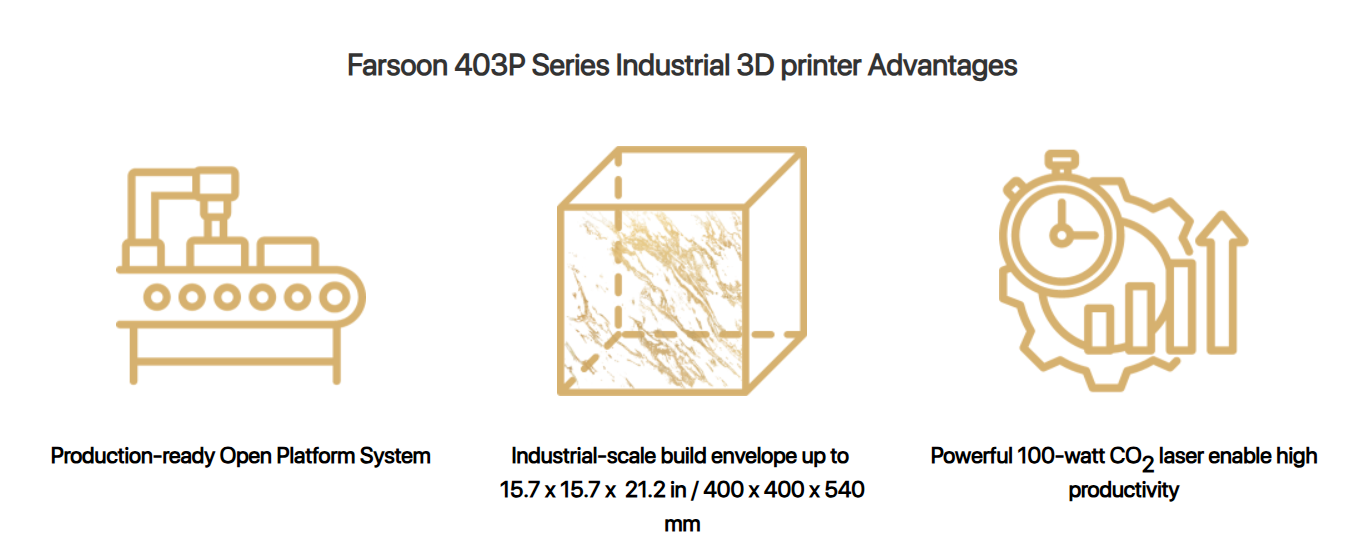
Combining high-precision dynamic focusing capability, scan speed of up to 15.2 m/s, with a high efficiency roller system and convenient removable powder cartridge system, the 403P offers increased productivity, manufacturing turn-over rates and lower price per part.
Open Platform
Farsoon is the first laser sintering system producer that allows for complete freedom of operation of its machines. This means that machine parameters and powder choice are unlocked for the user allowing for previously impossible levels of freedom and flexibility when it comes to PLS production.
Industrial Applications with 403P Series
Farsoon’s 403P series is engineered to do the job and to be productive, economy, and reliable. With the expanded build envelope, high-temperature capability and the flexibility with material choice, 403P Series has been the perfect choice for rapid prototyping and small batch end-use part manufacturing amongst many production-oriented customers.
MANN + HUMMEL Intake Pipe for Passenger Vehicle Engine System
Machine: HS403PThis intake pipe part required a fast design iteration for functional testing by the customer. Features a large size of 600mm (23.6 inches) with a new customized locking mechanism design, the functional prototyping part is able to be 3D printed in one single day, and shows excellent strength, good resistance under temperature, humidity and chemical corrosion conditions. Compared to the traditional process, the 403P produced part also helped saving investment in toolmaking while significantly reduced lead time.

FAW-Volkswagen Bumper Guide Brackets
Machine: HT403PThe brackets for bumper guides required a small batch of 30 pieces for functional testing, this quantity is challenging using silicone molds due to the complicated process of manufacturing, time consumed, and high cost of tool-making and manual labor. Compared to traditional silicon molding, the plastic laser sintering process achieved design to physical part time of only 14 hours compared to 78 hours, and a total of 72% production cost saving, of which the labor cost decreased from 1000 USD to only 60 USD.

Rhosoon Vehicle Antenna System
Machine: SS403PThe Luneburg lens design features a multi-layered structure within an extreme compacted volume, with varied layer thickness and many detailed features to offer different electromagnetic wave refraction by each layer. Using Farsoon 3D printing technology Rhosoon is able to significantly reduce design-to-market time, and simplify the manufacturing process by additively producing the complex antennas structure with fine detail resolution and quality control. It also enables Rhosoon to develop highly customized 3D printed antennas designs to best suit each application’s needs.


Produce high-strength, lightweight components for spacecraft, aircraft interiors, and UAVs. Ideal for parts requiring complex geometries, thermal resistance, and compliance with aerospace standards—such as ducts, housings, and structural brackets—manufactured in days instead of weeks.

Rapidly create large, single-piece automotive parts like HVAC housings, grilles, and spoilers without multi-part assembly. Enables functional testing, integrated design, and small-batch production with reduced tooling costs and faster iteration cycles.

Continuous powder feed and automated handling enable 24/7 output of both small intricate parts and large structural components. Perfect for service bureaus and OEMs producing thousands of end-use pieces with minimal downtime.
Shorten development cycles from days to hours with high-fidelity prototypes. Open-parameter, open-material capabilities allow engineers to experiment with material blends, fine-tune performance, and optimize production settings.
Manufacture patient-specific orthotics, surgical guides, and device housings with precise fit and biocompatible materials. The ability to produce intricate internal structures supports advanced medical research and device development.
Print durable jigs, fixtures, and robotic end-effectors tailored to specific production lines. High-performance materials like carbon-fiber or glass-filled polyamides deliver superior stiffness and wear resistance in demanding industrial environments.