Farsoon HT1001P-2 SLS 3D Printer: High-Precision Polymer Manufacturing

The Largest Plastic Laser Powder Bed Fusion System with Continuous Production Capacity.

Build Volume

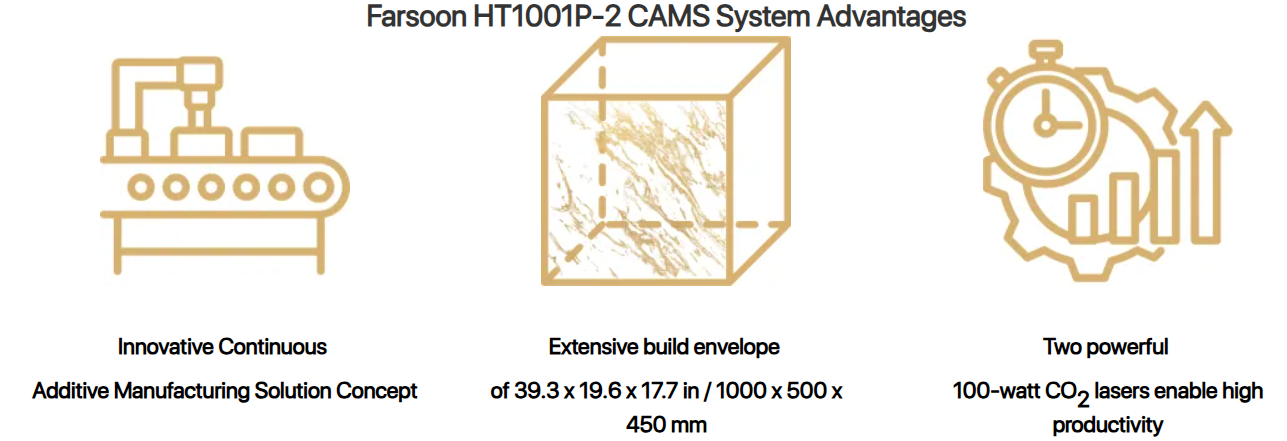
1000×500×450 mm

Dimensions

2680×2000×2980 mm (Build Station only), 5585×2000×2980 mm (Full module)

Technology

SLS
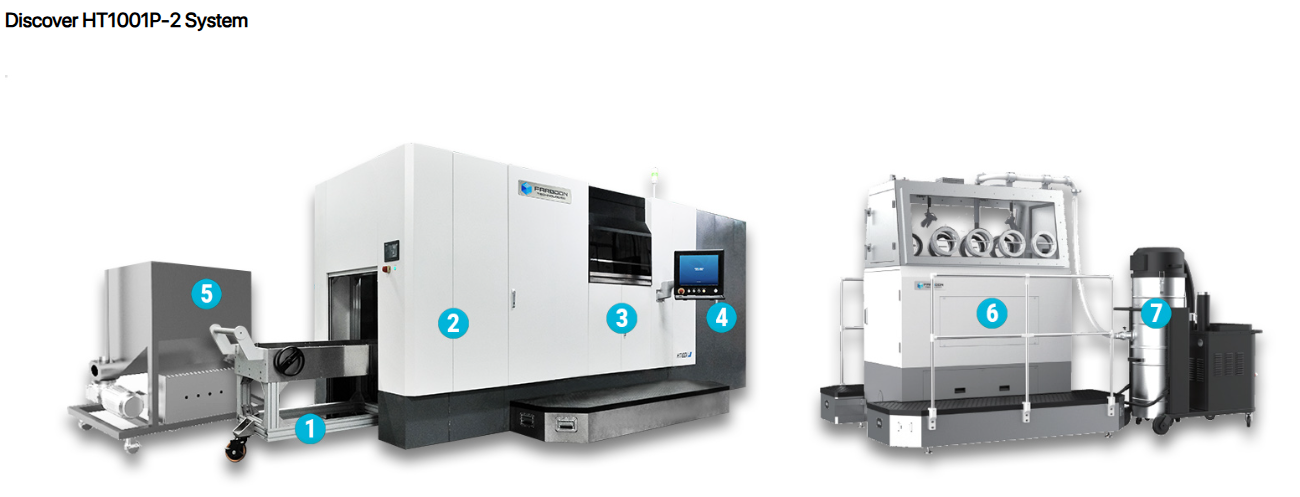
Introducing CAMS: Continuous Additive Manufacturing Solution CAMS is designed to revolutionize the additive manufacturing industry by enabling continuous production and aligning with Industry 4.0 models. This solution offers vertical scalability and modularity, ideal for integration into any industrial manufacturing environment.    
  • Cartridge Transportation Cart
  • Used for loading and extracting the build cartridge from the HT1001P-2 SLS 3D printer, ensuring stable movement during transitions.
 
  • Loading Station 
  • Located on the left side of the system, it utilizes an electric door and semi-automated conveyor for precise build cartridge loading.
 
  • Build Station 
  • The build Station module is where the sintering process takes place. Once the build cartridge is in place, the build packet files would be loaded into Farsoon’s BuildStarTM operating software, then the build process begins.
 
  • Cooling Station 
  • Upon build completion, the build cartridge is conveyed to cooling station where it will be allowed to cool under an inert atmosphere to control oxidation and part stability. The conveniently located control panel allows the user to program the cool-down environment to their specifications, as well controlling movement on the conveyor.
 
  • Powder Delivery System 
  • The powder is delivered by a highly efficient top-feed and roller-based recoating system and the parts are fused using a fully digital multi-laser / multi-scanning system that offers tremendous productivity.
 
  • Breakout Station 
  • The build cartridge is moved to breakout station via the conveyor system. The Breakout Station is fully enclosed and is accessed through multiple glove boxes on the front and back of the station allows the capability of multiple operators while retaining a clean working environment. The built-in air-guns allow for gentle powder removal and detailed cleaning.
 
  • Vacuum Cleaner 
  • The Breakout Station features a vacuum hose which allows the user to gently remove excess powder. The excess powder can then be recycled or discarded.
 

Designed for Production

The HT1001P-2 CAMS system is built for continuous batch production with minimal downtime. It features an efficient powder handling system, a multi-laser scanning setup, and scalable design for industrial applications.

Enhanced capabilities

With a build chamber temperature of up to 220°C, the HT1001P-2 can process high-performance materials like PA6 and PAI2, opening new possibilities for polymer 3D printing, including nylon 3D printing and polypropylene 3D printing.

Open & Modular

The HT1001P-2 is fully open, offering customizable parameters and an open material model, ensuring compatibility with future enhancements and seamless integration into existing production lines.

Powder management

The HT1001 P 2 ־ has also been designed with a comprehensive powder handling system featuring a closed loop powder system with increased automation and little need for operator interaction with the powder supply. With the HT1001P-2 the additive industry is ready to take the next steps towards true manufacturing.

Industrial Applications with HT1001P-2

With the industrial scale build size and enhanced production capability, CAMS HT1001P-2 offers many new opportunities for the next level plastic AM production: over-sized end-use piece can be produced in one-piece without the need for assembly; large-volume series production can be operated in faster turn-over rates for a significant lower price per part.

SAPW HAVC Housing

Machine: HT1001P-2

Material: FS3300PA (PA12)

Size: 950 x 423 x 207 mm

Build Time: 10 Hours

  Farsoon Technologies in collaboration with automotive partner SAPW has printed a single-piece polymer automotive HVAC (Heating Ventilating Air Conditioning) unit on the HT1001P-2 CAMS system. Compared to the traditional process including CNC and Silicone Molding, the additively manufactured HVAC features structural integration, improved performance, accelerated development cycle, and reduced manufacturing cost.

Static Firing Skirt on Long March-5 Rocket

Machine: HT1001P-2

Material: FS3300PA (PA12)

Size: 370 x 100 x 125 mm each

Build Time: 50 pieces produced in 48 hours

Scientists designed the optimized static firing skirt per operating conditions and manufactured the end-use parts using Farsoon HT1001P-2 laser sintering technology and high performance FS3300PA material. Assembled to a 5000mm-diameter cylinder structure, the additively produced static firing skirt features excellent strength and toughness, ease of assembly, good post-processability for water-proofing and salt spray to assess the extreme atmospheric corrosion resistance.

Qualcomm Automotive Grille

Machine: HT1001P-2

Material: FS3300PA (PA12)

Size: 900 x 370 x 160 mm

Build Time: 10 hours

This oversized front grille designed by Chongqing Qualcomm Automotive Group measures 900mm in length and featured many detailed structures with thin wall-thickness. Manufacturing with conventional machining process or standard sized SLS platform will require production in several pieces, assembly and polishing; which can cause issues including overall strength and structural integrity. Now at Farsoon, the front Grille can be produced with HT1001P-2 system in one single piece.

Use Cases

Aerospace & Space Hardware

Rocket parts: Static firing skirts for China’s Long March‑5 rocket (50× parts, ~370 × 100 × 125 mm each) were produced within 48 hours and assembled to a 5 m cylinder, meeting strength, toughness, and salt‑spray specs

Automotive & OEM

HVAC housing: A single-piece automotive heating‑ventilation‑air‑conditioning unit (950 × 423 × 207 mm), printed in PA12, in just ~10 hrs—replacing CNC+CIM with reduced cost, quicker prototyping, and integrated design.

Front grilles & spoilers: Oversized components (900 mm+) like car grilles and spoilers that usually require multi‑part assembly can be printed in one go, improving structural integrity and eliminating joints .

High‑Volume Production

Large-volume batch builds: The continuous powder feed and automated build/cartridge/conveyor stations enable 24/7 batch production of either many small parts or single large components with minimal downtime.

Service bureaus and OEMs: Industrial manufacturers like Chuanglian 3D and BMW employ the HT1001P for series production of large-format parts

Prototyping & R&D

Ideal for rapid, high-fidelity prototyping of large parts—e.g., custom ventilation housings—cutting traditional machining cycles from ~62 hrs to under 10 hrs.

Open‑parameter and open‑material platform supports experimenters in material testing and process optimization

Featured Parts Gallery

Products created with 3D Printer

Discover Additive Technologies

Connect With 3D Print

Most asked questions

Frequently asked questions

The A30 Metal 3D Printer supports a wide range of metal powders, including stainless steel, titanium, Inconel, cobalt chrome, aluminum, and more, giving you the flexibility to choose the right material for your project.
The A30 stands out for its compact size, making it perfect for small labs and tight spaces. Its 200W laser and energy-efficient design ensure high-quality, precise prints while keeping operating costs low.
With a maximum scanning speed of up to 10 m/s (32.8 ft/s), the A30 is designed for fast, efficient production to help meet your project deadlines.
Maintenance is straightforward and minimal, thanks to the robust build and high-quality industrial components. Regular checks and standard upkeep will keep it running smoothly, saving you time and effort.
The A30 has a compact build volume of Ø30 x 60 mm (Ø1.2 x 2.4 in), ideal for producing small, detailed parts such as prototypes, custom components, and educational models.
Yes, the A30 Metal 3D Printer is designed for simple setup and user-friendly operation. It fits through standard doors and elevators, making it easy to install in most lab or workshop environments.