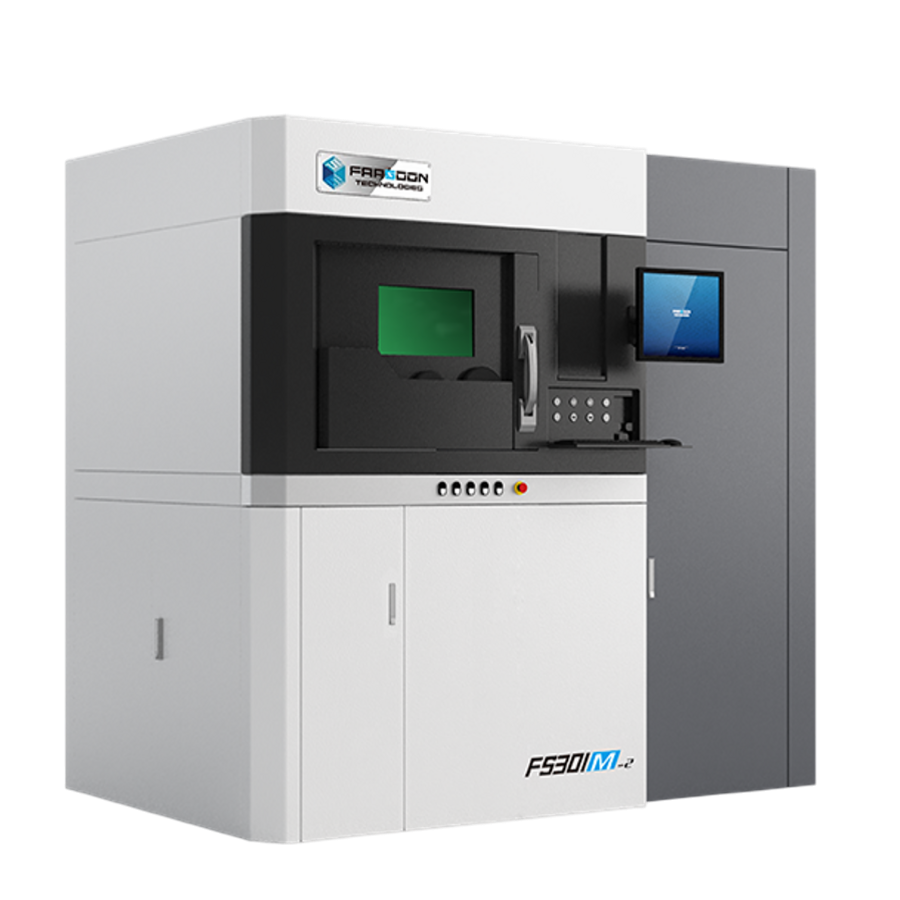
User-oriented, High Quality Metal Production System.
Build Volume
Dimensions
Technology
Introducing FS301M System.
By taking the pain points from our customers which focus around productivity, safety, stability, and ease of use, it led us to co-innovating with Farsoon’s key partners from various industries such as aerospace and tooling, Farsoon has created a system truly suited for industry. By working closely with these industry partners, the FS301M was designed to meet desired user operations, including production speed, powder management, machine factory layout, quality of finished parts, ease of operation and serviceability.
Discover FS301M System

Integrated Powder Loading Dock
With an integrated powder-loading dock, FS301M achieves a fully sealed material handling operation under an inert atmosphere for streamlined workflow and improved environmental safety.
Glove Box + Tool Access
The integrated, fully sealed glove box located in front of the FS301M system allows convenient and safe breakout operation when the build is completed. The unique attachment point located between the gloves offers quick and easy tool access for in-chamber operation without the user needing to come in contact with the powder.
Integrated Filtration System
The reactive material capable Recirculating Filter System offers efficient filtering of the smoke dust generated in the build chamber during the sintering process. Its advanced capability allows for long-lasting operation hours which help reduce the cost of filter changes.
Shared Metal Container
A shared material container is used during loading, unloading and the sieving procedures offering more convenient powder-handling and transportation between the stations.
Sieving Unit
The powder sieving unit features a vibration screen offering efficient sieving of recycled metal powder from the material containers to filter out the large particles. The metal powder collected in the refreshed powder container can be re-used for powder supply.
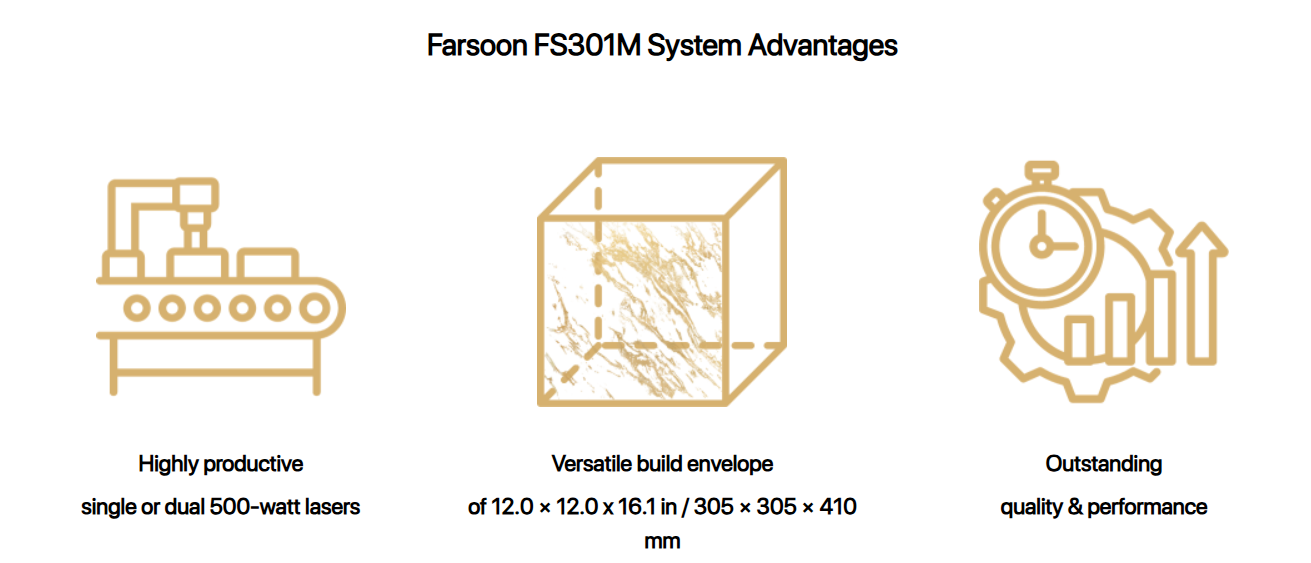
Productivity
Featuring an expanded build cylinder of 305x305x410 FS301M is well suited for largersized application within a single build. DualMaser scanning strategy and calibration algorithms enhance the build efficiency by precisely controlling dualsense operation with full coverage of the build area, achieving intelligent distribution of each laser while building a single large part or multiple smaller parts.

Quality
Paired with truly open parameters, FS301M offers ultimate control for metal AM production. Advanced 3-axis digital galvo system, powerful build process control & real-time monitoring, excellent air tightness design of FS301M ensure the best quality of the printed part.

Enhanced User Operation
With an integrated powdeMoading dock, FS301M achieves a fully sealed material handling operation under an inert atmosphere for streamlined workflow and improved environmental safety. A shared material container is used during loading, unloading and sieving process, offering convenient powder handling and transportation between the stations. Advanced features such as pre*heated base plate, electric leveling, and vision system ensure more robust process and quality control.

Compact Footprint
FS301M features a machine footprint as small as 3.64 sqm with an integrated, long*lasting filtration system of operation time up to 1500 hours. With designated operation access from only the front and the rear, FS301M achieves one of the most compact installation spaces among similar sized PBF systems on the market. In an additive factory setting, FS301M enables high density layout with minimal side distance to achieve maximum throughput per floor area at economical additive production cost.

Industrial Applications with FS301M
Farsoon’s openness to truly co-innovate by working with industry customers allows FS301M to be a truly user-friendly system. Created to meet the demanding requirements with an end use aviation customer in the U.S., the testing data from the joint process development on the FS301M for Ti6Al4V Titanium shows industry-leading performance for additive and near-wrought properties.
AUV Heat Exchanger Component
Machine: FS301M-2Thanks to the advanced Farsoon metal additive manufacturing, engineers are able to explore brand new design of this heat exchanger component with structural integration, light-weighting and mechanical strength. With this innovative design, the engineers are able to achieve total build time of 96 hours with 0.05mm layer thickness. The as-printed part features excellent surface quality that will only require easy post-processing, like heat-treatment, wire-cutting and sand blasting.

Automotive Gearbox Mount
Machine: FS301M-2This aluminum Gearbox mount is a key component on Siemens sponsored Formular Race Car; the design is optimized using Siemens NX software and fabricated by Farsoon FS301M-2. Thanks to the advanced additive technology, the part has achieved simplified manufacturing process, light-weight of only 1.119 kg while meet the same structural strength requirement. It also featuring excellent surface finish of 3um on vertical and 5um on horizontal.


The FS301M produced nickel-based superalloy turbine blades with optimized cooling channel designs. Additive manufacturing enabled complex geometries, reduced weight, and improved thermal efficiency compared to traditional casting methods.
Using titanium alloys, the FS301M created patient-specific orthopedic implants with porous lattice structures for enhanced osseointegration. This reduced recovery time and improved long-term implant stability for patients.

The FS301M manufactured lightweight aluminum and maraging steel components for high-performance vehicles. The design freedom allowed weight reduction, improved strength, and streamlined part integration without sacrificing durability.

The FS301M produced heat-resistant components for power generation, including Inconel and cobalt-chrome parts capable of withstanding extreme operating temperatures. This extended service life and reduced maintenance costs.
The FS301M fabricated conformal-cooled injection mold inserts with intricate internal channels. This resulted in faster cycle times, improved part quality, and enhanced thermal management during injection molding.